
About the Film
A conversation about coffee that becomes something else entirely.
An evening conversation. Two friends. A cup of coffee that becomes something neither of them planned on.
The Heavy Cup follows Isaac and Maya as a familiar ritual quietly opens into something far less comfortable — a conversation about dependence, desire, and the quiet normalization of the things we can no longer do without. Nothing happens loudly. Everything shifts.
At its core, the film asks a simple but unsettling question: what have you grown used to, that you may no longer be able to live without?
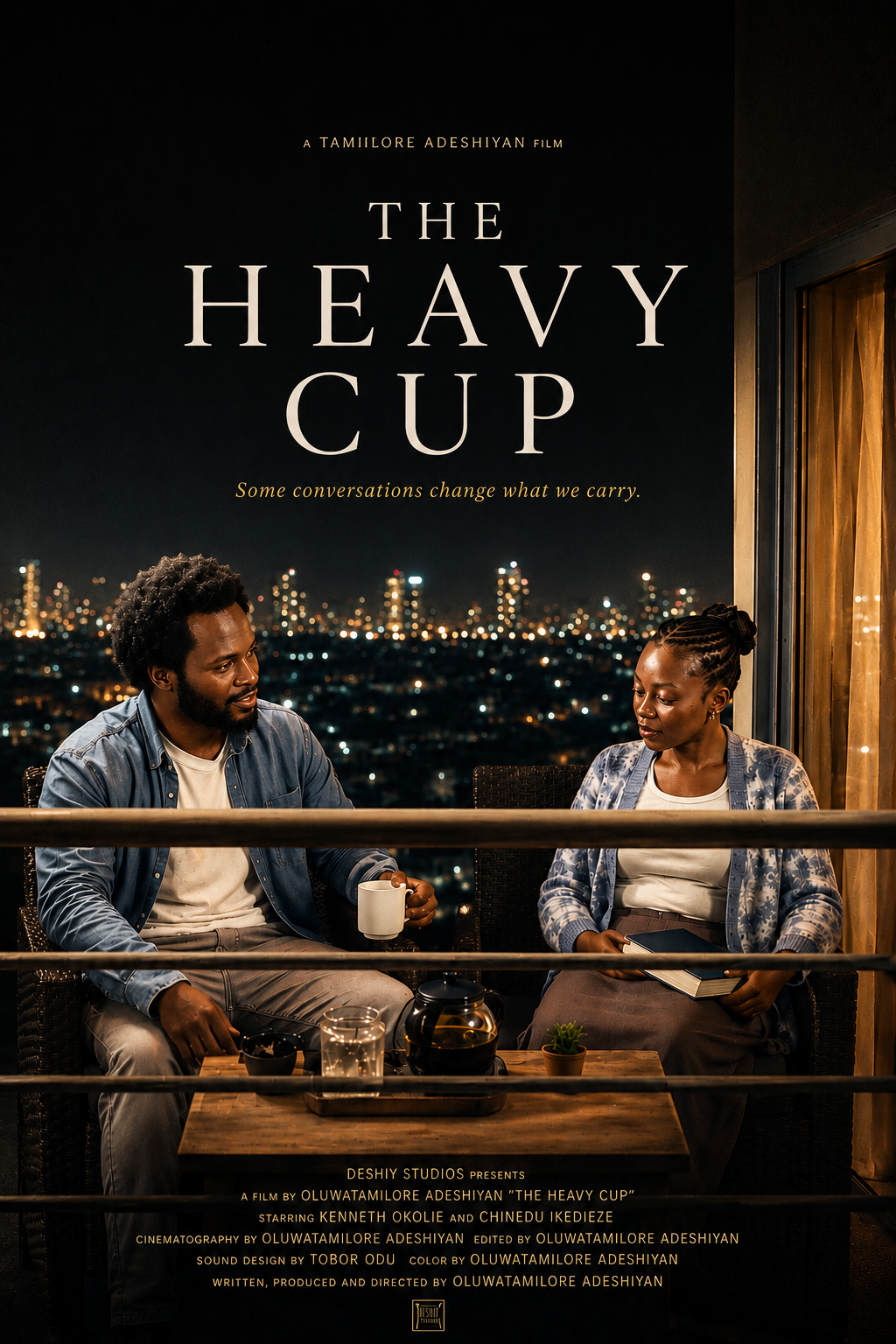
Two people. One evening. Everything unsaid.
Written by Oluwatamilore Adeshiyan. Script 4 — the most refined version of The Heavy Cup. A two-hander set on a Lagos balcony as daylight turns to city glow. Selected pages below.
ISAAC holds a coffee cup with two hands. A used sachet of Nescafé 2-in-1 sits on the table. MAYA has a flask. Her book is open, a finger marking the page. They have just stopped laughing.
MAYA
(soft smile, tail of laughter)
I thought you said you don't like coffee.
He looks down at the cup. Almost surprised, like he forgot he was holding it.
ISAAC
I don't.
MAYA
Mm.
She doesn't push. Returns her eyes to the book.
ISAAC
I drown it. Sugar. Milk. Sometimes cream. By the time I'm done, it doesn't even taste like coffee anymore.
A small, almost embarrassed smile.
ISAAC
(lifting the cup, absorbing the heat)
I just like the warmth.
ISAAC
(quietly, to himself)
It's beginning to taste… familiar.
He lingers on that word.
The cup is introduced as comfort, not habit. Isaac doesn't drink coffee — he drinks the idea of it. By Part 4, we've watched it become something else entirely without a single line announcing the shift.
The script calls for sound that feels alive but never intrusive: traffic, wind, a distant generator. This isn't backdrop — it's the film's third character.
The conversation has drifted into Michael Jackson, celebrity, the Early 2000s. MAYA takes a small sip from the flask. Then, almost without deciding to:
MAYA
(lightly, but the weight seeps through)
[A coma might actually be nice…]
(quieter)
[Sometimes… I just want everything off…]
She immediately grounds herself.
MAYA
Not that I want to die. Quick. Clear.
(a small nod)
Just… no noise. No thinking. No remembering.
Silence. The city hum feels louder now. He looks at her. Really looks. Doesn't react loudly.
ISAAC
You've… sat with this.
It's not a question.
MAYA
Escapism works… Until it doesn't. And then it collects interest.
MAYA
The focus is always about what people run to. But when you look closer, you see it's usually more about what they're running from.
ISAAC
(quietly)
I guess the end of the story is always louder than the beginning.
Maya's disclosure isn't dramatic — it arrives in the middle of a celebrity tangent. That's the point. This is how people actually talk about the hard things: sideways, almost by accident, and then quickly covered.
We never learn what's in Maya's flask. The script doesn't tell us. The film won't either. The ambiguity is the argument.
© 2026 Deshiy Studios. All rights reserved. Personal use only.
"It's strange what we call harmless."— Maya, The Heavy Cup
The work behind the work.
Materials from the making of The Heavy Cup — preserved as part of the Deshiy Studios archive.
Script 4 is the most refined version of The Heavy Cup. Four parts: Arrival/Warmth, The Baton, The Chosen One, and The Montage — a six-section visual sequence that draws a parallel between coffee rituals and other forms of dependence using identical cinematographic language. No faces. No hierarchy. Just behavior. The script's restraint is its argument.
The Heavy Cup began as a question about comfort — specifically the kind of comfort that doesn't ask permission. Isaac holds coffee he claims not to like. Maya holds a flask she never explains. Neither is asking for judgment. The film follows their logic rather than correcting it. What it chooses not to say is as deliberate as every line of dialogue.